Teaching as inquiry
Effective social studies teachers inquire into the teaching-learning relationship; they think about how they are teaching and whether it is working. This can be moment by moment as teaching takes place, day to day, or over a longer term as occurs when using a teaching as inquiry approach.
Focusing inquiry |
Teaching inquiry |
Learning inquiry
The New Zealand Curriculum offers generic information about effective pedagogy and describes a process for
teaching as inquiry (p. 35).
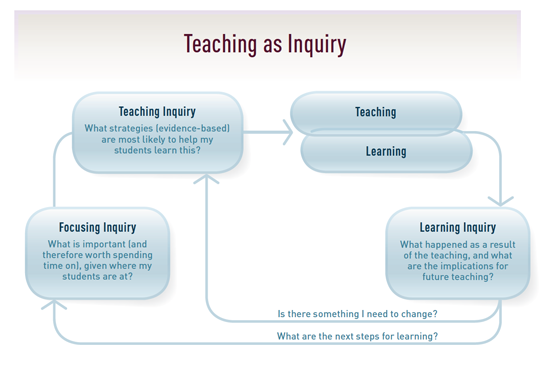
NZC_Teaching as inquiry diagram
If you cannot view or read this diagram,
select this link to open a text version.
The 'teaching as inquiry' diagram on page 53 of
Effective Pedagogy in Social Sciences / Tikanga ā Iwi (PDF 3.65MB) reinforces this approach to teaching.
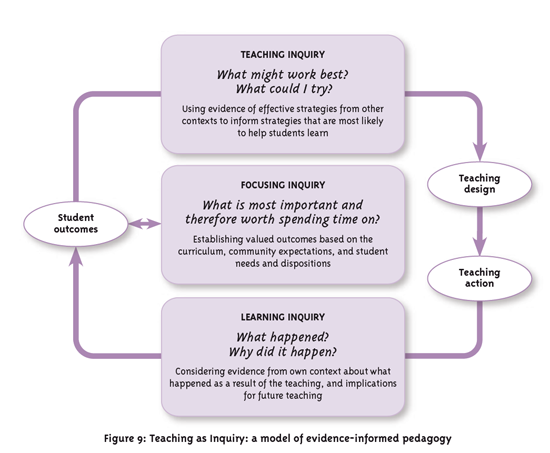
Effective pedagogy in SS_teaching as inquiry diagram
Teaching as inquiry is a cyclic process and involves teachers putting students at its heart while also reflecting on the effectiveness of their own approaches. It ensures the learning remains student centred and is immediately responsive to the success of the approach taken and reveals the need to revisit or adapt the strategies being used.
As teachers build their knowledge of both learner and learning, they model what it is like to be a lifelong learner. The cycle of inquiry is our best guarantee that we don’t carry on doing what we’re doing if it is no longer working or it is not working for particular students or groups of students.
To be effective, we should always be asking ourselves three questions:
-
What is it important for me to be teaching now? (focusing inquiry)
-
What strategies are most likely to help my students learn this? (teaching inquiry)
-
What worked and for whom, and what are the implications for my teaching? (learning inquiry)
Focusing inquiry
How will I know the learner?
Consider the culture of your students, and their interests, goals and aspirations in order to plan appropriate activities that connect to relevant contexts. Identify students with specific learning needs and ask them what helps them to learn.
How will I assess prior knowledge?
Consider accessing prior knowledge through interviews, conversations with learners, pre- and post-tests, questionnaires or surveys. Pre-testing might be undertaken using visuals like photographs as a stimulus to get students to write what they know about a topic/event. Post tests might repeat the pre-test process to track development or seek in-depth information revealing knowledge, skills, and understanding of the key learning dispositions or competencies. Consider also what format to use in order to assess prior knowledge and the framing of the questions. There are more examples in the
Effective Pedagogy in Social Sciences: Tikanga ā Iwi: BES (pp. 237-242).
What knowledge is important?
Consider what factual knowledge and conceptual understandings are important. For example, when investigating 'Boy racers: car crushing'
(see level 7 achievement objectives), determine what relevant laws the students are aware of, their personal concept of the relevant ‘rights’, and the students' own value positions. This could be done giving sentence starters for the students to complete.
Identifying student prior knowledge can alert teachers to misunderstandings that they can plan to address, and student experience on which to build engagement with new learning.
TOP
Teaching inquiry
What evidence-based strategies are most likely to help my students learn? This involves asking questions about how well current strategies are working and whether others might be more successful.
Consider student engagement and achievement and in particular the engagement of boys, Māori, and Pasifika. Ask how effective your current strategies are, and which learning outcomes these strategies address.
Choose the strategy for the specific learning outcome such as:
- graphic organisers
- co-operative strategies
- writing and presenting
- using visual and oral presentation
and encourage the use of digital media.
Choose topics of immediate relevance to the cultures and sub-cultures of your learners, for example, the riches and tensions of diversity in New Zealand, belief systems, changing families, and lifestyle choices. Consider current issues such as binge drinking, the car cults, social networking, cyber bullying, and the impact of musical cultures like hip hop and reggae.
Consider when and how to formatively assess and give feedback and feed forward
.
Resources on effective teaching
TOP
Learning inquiry
Ask yourself:
- What happened as a result of the teaching?
- Were the students engaged and interested?
- Did they understand the essential learning intention to the required depth?
- Do the students want to know more?
For example, when teaching a unit on 'changes in the New Zealand family', assess if students recognise different family structures and understand the consequences of changing family structures in the past, and the impact for the future development of New Zealand society. This could be group or peer-based feedback by mini-whiteboards, poster chart, or oral report on particular family structures.
What data could be collected?
Check progress with a task to check the level of student engagement when learning is taking place in class. Use a feedback/feed-forward sheet to establish ‘what I know that I know / what I still need to know’.
Students might write a single paragraph showing their depth of understanding on one key concept or idea. For example, in a level 7 study of the effects of gender perceptions on employment, students might ‘explain one significant long term, and one short term consequence of delayed child bearing due to longer education pathways and career establishment’. The teacher can quickly identify the depth of understanding and offer feed-forward advice.
If learning is based around a social inquiry, consider collecting evidence for each stage of the inquiry. A short written feedback / feed-forward sheet might help students.
Tracking student progress
The following is an example for tracking student progress in level 7 research, which can form the basis of a ‘learning conversation’ and indicate directions needed for success.
Using self-assessment the teacher can plan the next steps, perhaps to re-teach to a particular group, run mini-workshops for those needing skills support, or have an individual conference with a student.
What do I need to change?
Ask your students if they enjoyed the learning experience and if/how your teaching strategies are working for them. Is the desired learning occurring for all students?
Consider teacher behaviour such as:
- positioning
- language used
- volume, tone
- body language
- classroom management
- questioning techniques
- strategies you use to engage your learners.
Are they being given opportunities to take ownership of their learning?
« Pedagogy
Last updated September 23, 2020
TOP